

TF-CBT Therapy in Royal Palm Beach, FL
When Big Feelings Come From Bigger Experiences
If you’ve ever asked your child what’s wrong and gotten a very convincing “nothing” followed by a slammed bedroom door, you already know that children aren’t always great at explaining what’s going on inside their heads.
When a child has experienced trauma, those feelings can be even harder to put into words. Instead, they might show up as nightmares, meltdowns, stomachaches, or suddenly wanting nothing to do with activities they used to enjoy.
Trauma-Focused Cognitive Behavioral Therapy (TF-CBT) helps children and teens understand what they’re experiencing, work through difficult memories, and develop healthier ways to manage those big feelings.
What Is Trauma-Focused Cognitive Behavioral Therapy (TF-CBT)?
TF-CBT is an evidence-based form of therapy designed specifically for children and adolescents, typically ages 3 to 18, who are struggling with the effects of trauma.
It combines cognitive behavioral therapy, emotional coping skills, trauma processing, and caregiver involvement to help young people make sense of difficult experiences.
Unlike traditional talk therapy, TF-CBT is adapted to a child’s developmental level. Because explaining the connection between thoughts, feelings, and behaviors to a six-year-old requires a slightly different approach than explaining it to an adult.

When Behavior Is Trying to Tell You Something
Trauma doesn’t always announce itself. Sometimes, it shows up looking remarkably like an attitude problem, a short attention span, or an ongoing battle over bedtime.
Children and teens affected by trauma may become more irritable, anxious, withdrawn, clingy, or easily overwhelmed. They may struggle at school, have difficulty trusting others, or blame themselves for things that were never their responsibility.
TF-CBT helps children understand what’s happening beneath those reactions and gives them practical tools to manage them.
Sometimes, understanding the why behind a behavior makes a big difference in how everyone responds to it.
How Does TF-CBT Work?
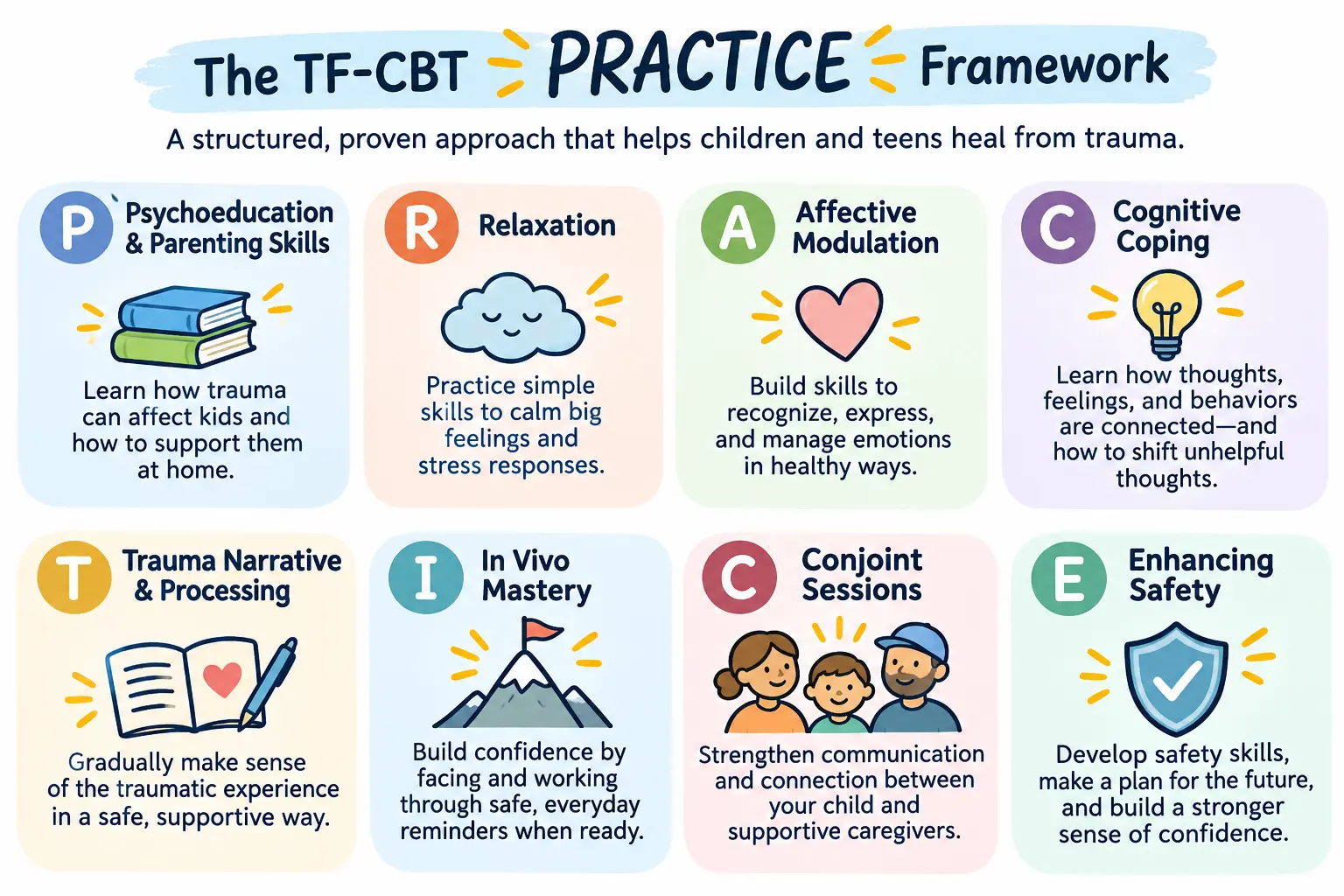
TF-CBT follows a structured approach known as PRACTICE. And yes, there’s an acronym. Therapists do love their acronyms.
- P – Psychoeducation and Parenting Skills: Understanding trauma and learning supportive parenting strategies.
- R – Relaxation: Learning how to calm the body’s stress response.
- A – Affective Modulation: Recognizing, expressing, and managing emotions.
- C – Cognitive Coping: Understanding how thoughts, feelings, and behaviors influence one another.
- T – Trauma Narrative and Processing: Gradually making sense of traumatic experiences.
- I – In Vivo Mastery: Working through fears and avoidance of safe trauma reminders when appropriate.
- C – Conjoint Sessions: Strengthening communication between children and supportive caregivers.
- E – Enhancing Safety: Developing safety skills and building confidence for the future.
Depending on the child’s age, sessions may incorporate drawing, storytelling, games, and other interactive activities. Not everything needs to involve sitting on a couch and talking.
Parents, You’re Part of This, Too
Don’t worry. There isn’t a parenting exam at the end.
One of the things that makes TF-CBT different is its emphasis on involving safe, supportive parents and caregivers whenever appropriate.
Caregivers learn how trauma affects children, how to respond to challenging behaviors, and how to support the skills their child is developing in therapy.
You may find yourself understanding some behaviors differently, feeling less frustrated, and becoming more confident about what to do when things get difficult.
You don’t have to be a therapist at home. Your child needs you to be their parent or caregiver, and therapy can help you feel better equipped for that role.
Will My Child Have to Talk About What Happened?
It’s understandable to worry that talking about trauma might make things worse.
TF-CBT doesn’t begin by asking children to tell their entire story. First, they learn coping skills, develop trust with their therapist, and build the emotional tools they’ll need to work through difficult memories.
Trauma processing is introduced gradually and in an age-appropriate way, helping children make sense of what happened, challenge misplaced guilt or self-blame, and reduce the distress associated with those memories.
Let’s Make More Room for Being a Kid
Childhood should have room for scraped knees, questionable fashion choices, ridiculous jokes, and getting excited about things adults have long since stopped finding exciting.
Trauma can interfere with those experiences, but it doesn’t have to define a child’s future.
At Ingram & Associates Counseling & Consulting in Royal Palm Beach, FL, we offer Trauma-Focused Cognitive Behavioral Therapy to help children, teens, and their families work through trauma, rebuild a sense of safety, and move forward with greater confidence.
Growing up is already a big enough job. Your child doesn’t have to navigate the effects of trauma alone.
Frequently Asked Questions About TF-CBT
1. How do I know if my child needs trauma-focused therapy?
If you’ve noticed lasting changes in your child’s mood, behavior, sleep, relationships, or school performance following a difficult experience, it may be worth talking with a therapist. You don’t need to figure out exactly what’s wrong before reaching out.
2. Can TF-CBT help if the trauma happened years ago?
Absolutely. Children may process experiences differently as they grow older and begin to understand them in new ways. There isn’t an expiration date on getting help.
3. Does my child need a PTSD diagnosis to benefit from TF-CBT?
4. How long does TF-CBT typically take?
TF-CBT is often completed in 12 to 25 sessions, although treatment length depends on the child’s experiences, symptoms, and individual needs.
5. What if my child refuses to go to therapy?
Not every child is going to jump for joy when you announce a therapy appointment. A therapist can help build trust, reduce uncertainty, and make the experience feel more comfortable.
6. Can TF-CBT help with more than one traumatic experience?
Yes. TF-CBT can address multiple traumatic experiences, with treatment adapted to the child’s history and emotional needs.
7. What if my child seems fine most of the time?
Children can laugh, play, and have good days while still struggling with the effects of trauma. Enjoying life and needing support aren’t mutually exclusive.
8. Will I know everything my child tells their therapist?
Not necessarily. Children and teens need some privacy to feel comfortable opening up. Your therapist will explain confidentiality, its limits, and how you’ll be involved in treatment.
9. What if I’m struggling with what happened to my child, too?
That’s understandable. TF-CBT includes support for caregivers, and individual counseling may also be helpful if you’re experiencing significant distress of your own.
10. Can TF-CBT help my child stop blaming themselves?
Yes. Helping children recognize and challenge misplaced guilt, shame, and self-blame is an important part of TF-CBT.
11. What if my child gets upset between appointments?
Your therapist can help you develop strategies for supporting your child at home. Progress isn’t always a straight line, and a difficult day doesn’t mean therapy isn’t working.