

Individual Therapy in Royal Palm Beach, FL
Sometimes life gets complicated. Sometimes really complicated. And sometimes you’re doing everything you know how to do, but still feel stuck, overwhelmed, or just not quite like yourself.
Individual therapy gives you a private, supportive place to sort through what’s going on without judgment—or having to pretend you have it all figured out. (If you did, you probably wouldn’t be looking for a therapist.) At Ingram & Associates in Royal Palm Beach, Florida, our therapists provide personalized mental health counseling for anxiety, depression, trauma, grief, relationship difficulties, life changes, and all the other things life has a habit of throwing our way.
Therapy, Counseling, Psychotherapy… What’s the Difference?
Therapy, counseling, psychotherapy—there are a lot of words for what happens in that room. While the terms can have slightly different meanings depending on the setting, they’re often used interchangeably when people are looking for professional mental health support.
At Ingram & Associates, our therapists provide individual counseling and psychotherapy based on your needs, goals, and what brings you through the door. Whether you searched for an individual therapist, counselor, psychotherapy, or individual therapy in Royal Palm Beach, you’re essentially looking for the same important thing: someone you can trust who can help you understand what’s going on and work toward meaningful change.
We’re less concerned with what you call it and more concerned with making sure it actually helps.
What to Expect from Individual Therapy
Therapy isn’t about lying on a couch while someone silently takes notes and occasionally asks, “And how does that make you feel?” (Unless you really like couches. We do have comfortable ones.)
Individual therapy is a conversation and a collaboration. You and your therapist will talk about what brought you in, what you’d like to change, and what might actually help. Along the way, you’ll have space to explore your thoughts, emotions, behaviors, relationships, and experiences without judgment.
Sessions typically last about 45–55 minutes. How often you meet and how long you stay in therapy depends on your needs and goals. Some people come in to work through one specific challenge. Others stay longer for ongoing support, personal growth, or because life keeps coming up with new material.

How Individual Therapy Can Help
You don’t have to be in crisis to benefit from therapy. Maybe something big happened. Maybe a lot of little things have piled up. Or maybe you can’t quite put your finger on what’s wrong—you just know you’re tired of feeling this way. Individual therapy can help you make sense of what’s happening, recognize patterns that may be keeping you stuck, and find healthier ways to move forward.
- Anxiety, excessive worry, or panic
- Depression, sadness, or loss of interest
- Trauma and post-traumatic stress
- Grief and loss
- Stress and feeling overwhelmed
- Major life changes and transitions
- Relationship and interpersonal difficulties
- Low self-esteem or lack of confidence
- Difficulty managing emotions
- Attention, focus, or motivation challenges
- Unhealthy patterns or coping behaviors
- Personal growth and greater self-understanding
Benefits of Individual Therapy
Therapy probably won’t make your problems magically disappear. (We’d love to offer that package.) What it can do is help you understand yourself better, build healthier ways of handling what life throws at you, and make changes that actually feel sustainable. The benefits are different for everyone, but here are a few you might notice along the way:
Deeper self-awareness and insight
Healthier coping and emotional regulation
Improved relationships and communication
Stronger boundaries and healthier patterns
Greater confidence and personal growth

Is Individual Therapy Right for Me?
There’s no official checklist that says, “Yep, time to see a therapist.” Sometimes you know exactly what’s bothering you. Other times, things just feel off. You may be overwhelmed, repeating patterns you’re tired of repeating, or wondering why something that “shouldn’t be a big deal” feels like a very big deal. Therapy can be a good place to start sorting that out.
- You feel overwhelmed, stuck, or unable to cope with everyday stress.
- Your emotions feel difficult to understand or manage.
- Worry, fear, sadness, anger, or other feelings are interfering with daily life.
- You’re having difficulty concentrating, sleeping, or staying motivated.
- Your relationships are becoming strained or repeating unhealthy patterns.
- You’re struggling to adjust to a loss, transition, or significant life change.
- Past experiences continue to affect how you feel or respond today.
- You want greater self-awareness, confidence, or clarity about what you want.
Getting the Most From Therapy
Therapy works best when you’re an active participant in the process. That means being open and honest with your therapist—even when the honest answer is, “I really don’t want to talk about this today.” That’s okay. Sometimes those are the conversations worth having.
Progress doesn’t always travel in a perfectly straight line, either. Some weeks you may feel like you’re making huge strides. Other weeks, you might wonder if you’re getting anywhere at all. Both can be part of the process.
And if something in therapy isn’t clicking, say so. Your therapist won’t be offended—we promise. Therapy is collaborative, and your feedback helps us figure out what works for you, rather than trying to force you into an approach that doesn’t fit.
FAQs
1. How do I know if I need therapy?
You don’t need to be in crisis or have a diagnosis to benefit from therapy. If something is affecting your mood, relationships, work, daily life—or you’re simply tired of trying to figure it all out on your own—it may be worth talking with a therapist. You’re also allowed to come to therapy because you want to grow, understand yourself better, or make a change. No crisis required.
2. How do I know if my therapist is the right fit?
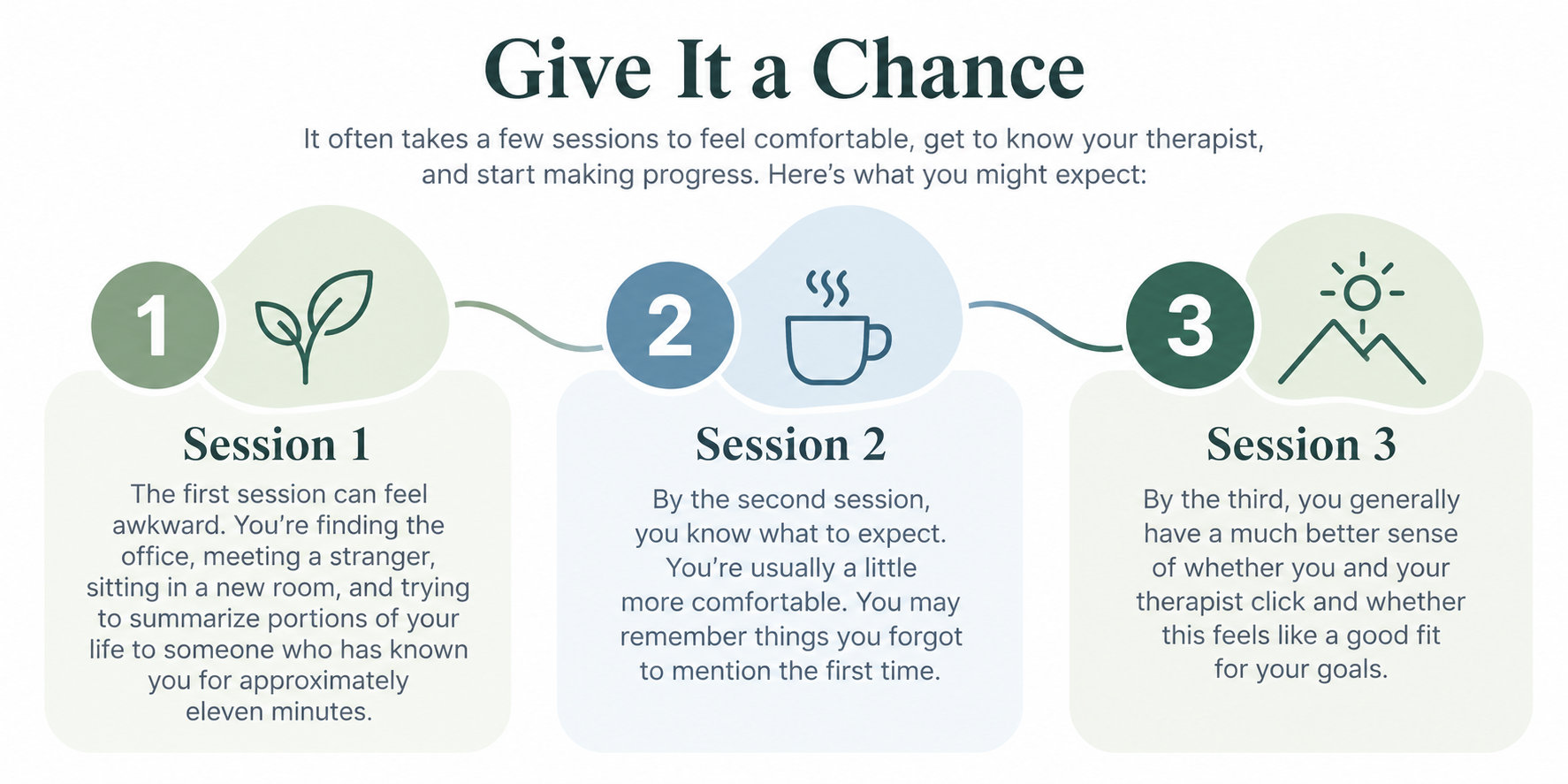
We usually recommend giving it three sessions. The first session is new—you’re finding the office, meeting your therapist, sitting in the room, and figuring out what to expect. That’s a lot before you even get to the therapy part.
By the second session, things feel a little more familiar. You may find yourself opening up more, or remembering the three things you meant to mention the first time but completely forgot. (It happens.)
By the third session, you’ll usually have a much better sense of whether the chemistry feels right. And if it doesn’t? That’s completely okay. The goal isn’t to make you fit the therapist; it’s to find a therapist who fits you. If another therapist on our team seems like a better match for your personality, needs, or communication style, we’re happy to help make that connection.
Therapy is personal. You should feel comfortable with the person sitting across from you.
3. What if I don’t know what to talk about?
Totally normal. You don’t need to walk into therapy with an agenda, a list of talking points, or even a clear explanation of why you’re there. Sometimes the starting point is simply, “I don’t really know where to begin.”
Your therapist can help guide the conversation with questions and help you figure out what feels important. And sometimes the thing you casually mention five minutes before the session ends turns out to be the thing. Therapists are very familiar with the last-five-minute plot twist. 😄
4. How often will I need to come to therapy?
It depends on you, your goals, and what you’re working through. Most people start with weekly sessions because consistency gives you and your therapist time to build trust, develop a strong therapeutic relationship, and keep some momentum between sessions. After all, it’s a little hard to get comfortable talking about your life with someone you barely remember meeting.
As therapy progresses, you and your therapist may decide that every other week—or another schedule—makes more sense. We’ll talk about what’s working and adjust along the way.
Therapy isn’t a subscription you forgot to cancel. We want you here because it’s helpful, and the frequency of your sessions should reflect what you actually need.
5. How long will I need to be in therapy?
There’s no magic number of sessions—and unfortunately, therapists don’t come with a progress bar that says, “You’re 73% done.” Therapy looks different for everyone.
Some people come in to work through a specific issue and feel ready to wrap up after a relatively short period of time. Others benefit from longer-term support as they work through more complex concerns, make changes, or continue growing.
You and your therapist will check in about your goals and progress along the way. The goal isn’t to keep you in therapy forever. It’s to use the therapy room to build insight, learn and practice new skills, and try out healthier ways of handling things—then gradually take what’s working with you into everyday life. Eventually, we’d like you to need us less. That’s kind of the point 😉.
6. Is individual therapy confidential?
Yes. What you share in therapy is private, and protecting your confidentiality is an important part of building the trust that makes therapy work.
There are some legal and ethical exceptions to confidentiality, such as certain situations involving immediate safety concerns, abuse or neglect, or when disclosure is required by law. Your therapist will explain those limits so you know what to expect.
Otherwise, therapy is your space to talk openly—even about the stuff you definitely do not want showing up in the family group chat.