

OCD
When Your Brain Won’t Let Something Go
You checked the door. You know you checked the door. You can practically picture yourself turning the lock.
But halfway down the road, a thought pops into your head:
What if I didn’t?
And just like that, you’re mentally retracing your steps, debating whether to turn around, and wondering why something so simple suddenly feels so complicated.
For someone experiencing obsessive-compulsive disorder (OCD), moments like these can become part of an exhausting daily cycle.
OCD isn’t just about liking things clean, organized, or arranged a certain way. It’s about unwanted thoughts, fears, or doubts that keep demanding attention—and the overwhelming urge to do something to make the discomfort go away.
At Ingram & Associates Counseling & Consulting, we understand how frustrating it can be when your mind won’t give you a break. Counseling can help you better understand these patterns and develop healthier ways to respond.
Because you deserve to spend more time living your life and less time negotiating with your own thoughts.
We Joke That It Should Be Called CDO
Around here, we therapists sometimes joke that OCD should really be called CDO—you know, so the letters are in alphabetical order, the way they should be.
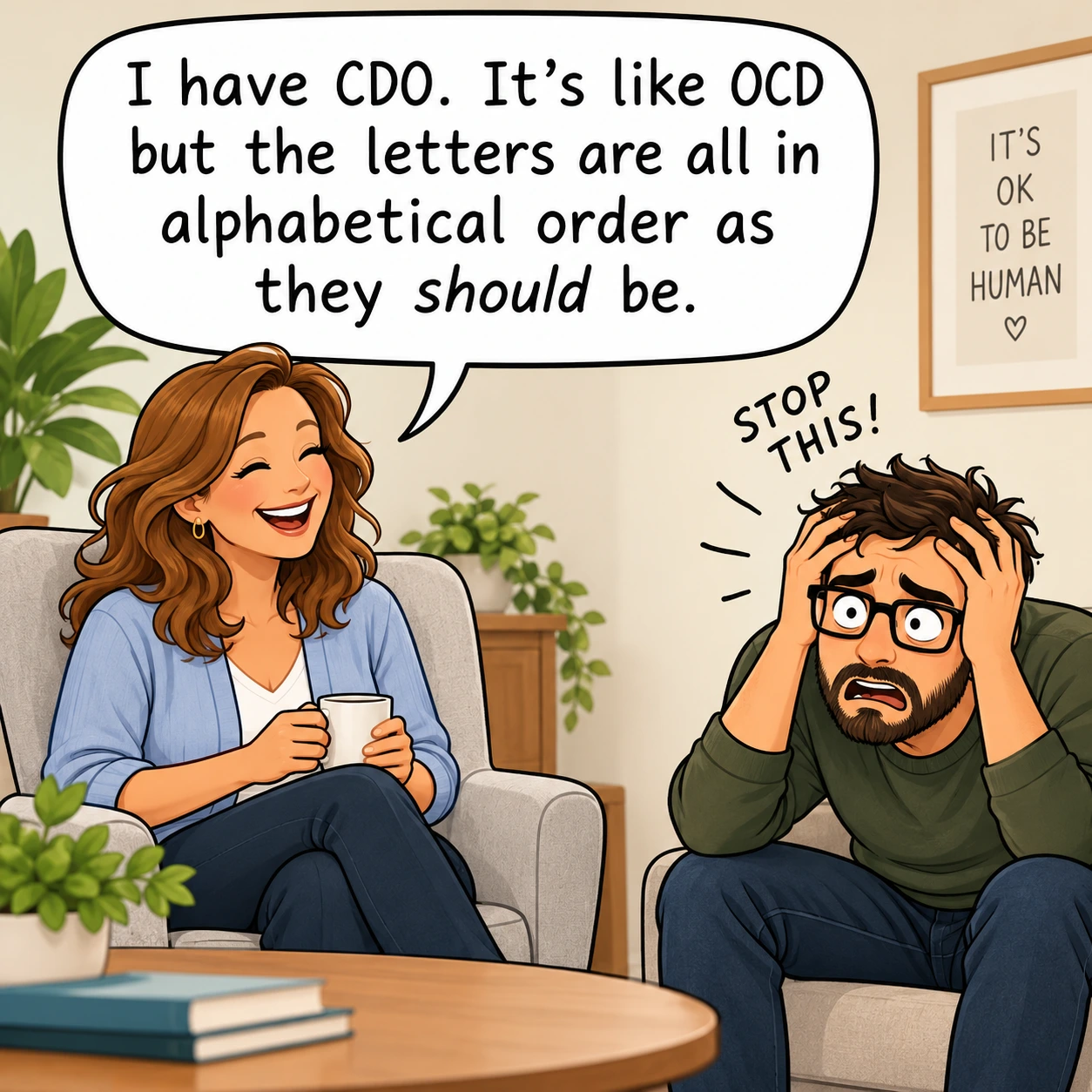
If you’ve ever straightened a crooked picture frame, reorganized a drawer that was already organized, or felt the need to fix something that was just a little out of place, you probably get the joke. We certainly do. Some of us have our own little quirks about how things ought to be.
And that’s part of being human. We all have preferences, habits, and things that bug us more than they probably should.
But there’s an important difference between liking things a certain way and living with obsessive-compulsive disorder. OCD isn’t simply about being organized, particular, or a perfectionist. It can involve unwanted thoughts, overwhelming doubt, and rituals that feel impossible to resist—even when you know they don’t make logical sense.
So yes, we can laugh at ourselves for wanting the letters in the right order. Sometimes a little humor helps us recognize our shared human quirks.
We also know that when those quirks become distressing, time-consuming, or interfere with everyday life, it’s no longer just a funny personality trait. And that’s when understanding, compassion, and the right support really matter.
What Is OCD?
Obsessive-compulsive disorder (OCD) is a mental health condition involving obsessions, compulsions, or both.
Obsessions are recurring, unwanted thoughts, images, or urges that cause anxiety, distress, or discomfort.
Compulsions are repetitive behaviors or mental rituals someone feels driven to perform, often to reduce that distress or prevent something feared from happening.
For example, someone might repeatedly worry that they’ve left the stove on, even after checking it. To ease the anxiety, they check again. And again.
The checking may bring temporary relief, but before long, the doubt returns.
That’s one of the frustrating things about OCD: the more you try to satisfy its demand for certainty, the more convincing that demand can become.
OCD can affect people in many different ways, and not everyone experiences the same kinds of thoughts or rituals.
The OCD Cycle: Why Reassurance Never Seems to Last
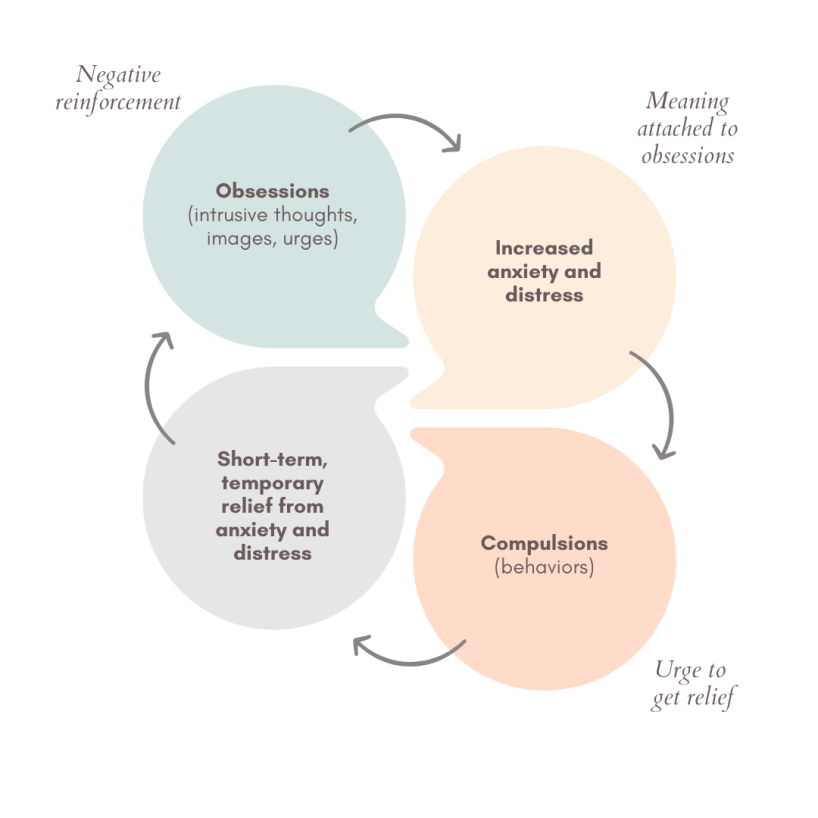
One of the most difficult parts of OCD is how convincing the cycle can feel.
1. An Unwanted Thought Shows Up
A thought, image, or doubt appears unexpectedly.
What if I accidentally hurt someone? What if I touched something contaminated? What if I made a terrible mistake?
The thought may feel disturbing precisely because it goes against what matters to you.
2. Anxiety or Discomfort Builds
You may feel anxious, guilty, uncertain, or responsible for preventing something bad from happening.
Your brain starts demanding an answer.
Preferably immediately. Preferably with a guarantee.
Unfortunately, life doesn’t hand out many guarantees.
3. You Feel Driven to Do Something
You might check, clean, repeat an action, seek reassurance, mentally review an event, or avoid a situation altogether.
These actions are attempts to feel safer or more certain.
4. Relief Arrives—But Doesn’t Stay
For a moment, you feel better.
Then the doubt returns, and the cycle begins again.
Over time, compulsions can strengthen the pattern by teaching your brain that the ritual was necessary to feel safe.
Understanding this cycle is an important first step toward changing your relationship with obsessive thoughts and compulsive behaviors.
Common Signs and Symptoms of OCD
OCD doesn’t look the same for everyone.
Some symptoms are easy to notice, while others happen entirely inside someone’s mind.
Common experiences may include:
- Repeated checking: Feeling compelled to check locks, appliances, messages, or other details over and over.
- Contamination fears: Excessive worry about germs, illness, chemicals, or feeling contaminated.
- Repetitive cleaning or washing: Washing hands, showering, or cleaning beyond what’s necessary to manage everyday hygiene.
- Unwanted intrusive thoughts: Disturbing thoughts or images that feel inconsistent with your values or intentions.
- Needing things to feel just right: Repeating or arranging actions until they feel complete, balanced, or correct.
- Seeking reassurance: Frequently asking others to confirm that nothing bad has happened or that everything is okay.
- Mental rituals: Silently counting, repeating phrases, reviewing memories, or trying to cancel out unwanted thoughts.
- Fear of making mistakes: Spending excessive time reviewing decisions or worrying about possible consequences.
- Avoidance: Staying away from people, places, objects, or situations that might trigger obsessive thoughts.
- Difficulty tolerating uncertainty: Feeling an intense need to know something for sure before moving forward.
You don’t have to experience all these symptoms to struggle with OCD.
And having an occasional intrusive thought or checking something twice doesn’t automatically mean you have the condition.
The important questions are how much distress these experiences cause and how much they interfere with everyday life.

OCD Isn’t Just About Being Neat or Organized
You’ve probably heard someone say, “I’m so OCD about that,” because they like their desk organized or their towels folded a certain way.
But enjoying an organized space isn’t the same as having obsessive-compulsive disorder.
OCD isn’t defined by how tidy someone’s home is.
A person with OCD might have a perfectly ordinary-looking house while spending hours mentally reviewing conversations, questioning their intentions, or trying to feel certain that they haven’t made a mistake.
Someone else may struggle with contamination fears, checking rituals, or the need to repeat certain actions.
The common thread isn’t perfectionism or cleanliness. It’s the distressing relationship between unwanted thoughts, anxiety, and behaviors intended to make that anxiety go away.
And for many people, the hardest parts of OCD are the ones nobody else can see.
How OCD Can Affect Everyday Life
OCD has a way of turning ordinary moments into complicated decisions.
Leaving the house can take longer because you need to check something again.
Sending a simple text message may involve rereading it repeatedly to make sure you didn’t say anything wrong.
A conversation can replay in your head for hours while you search for reassurance that you haven’t offended someone.
Even relaxing can become difficult when your brain keeps presenting another question that feels urgently important.
Over time, OCD may affect:
- Relationships and family routines
- Work or school performance
- Sleep and concentration
- Decision-making and confidence
- Daily schedules and responsibilities
- Emotional well-being and quality of life
Family members and partners may also become involved in rituals or repeated reassurance, often because they genuinely want to help.
But while reassurance can provide short-term comfort, it may unintentionally keep the OCD cycle going.
The good news is that these patterns can be addressed with appropriate treatment.

How Counseling Can Help With OCD
OCD treatment isn’t about convincing you that every worry is impossible or promising that nothing bad will ever happen.
It’s about helping you respond differently when uncertainty and unwanted thoughts show up.
One of the most effective, evidence-based approaches for OCD is Exposure and Response Prevention (ERP), a specialized form of cognitive behavioral therapy (CBT).
ERP involves gradually and collaboratively facing situations or thoughts that trigger OCD-related distress while learning to resist the compulsions that normally follow.
Over time, this can help weaken the cycle and build greater tolerance for uncertainty.
Depending on your needs, counseling may focus on:
- Understanding your OCD patterns: Identifying obsessions, compulsions, avoidance, and reassurance-seeking.
- Recognizing intrusive thoughts: Learning that having an unwanted thought doesn’t make it meaningful, dangerous, or a reflection of your character.
- Reducing compulsive behaviors: Developing ways to respond to distress without relying on repetitive rituals.
- Building tolerance for uncertainty: Practicing moving forward without needing absolute reassurance.
- Addressing avoidance: Gradually becoming more comfortable with situations you’ve been avoiding.
- Supporting relationships: Helping loved ones understand OCD without unintentionally reinforcing its patterns.
- Reclaiming everyday activities: Spending less time responding to OCD and more time doing things that matter to you.
Effective OCD treatment should be tailored to your symptoms and provided by a clinician trained in appropriate approaches, particularly ERP when indicated.
You don’t have to win every argument with your brain. Sometimes progress means learning that you don’t have to participate in the argument at all.
Intrusive Thoughts Don’t Define Who You Are
One of the most distressing aspects of OCD can be the content of intrusive thoughts.
Some people experience unwanted thoughts involving harm, relationships, religion, sexuality, morality, or other deeply personal subjects.
These thoughts can feel frightening, embarrassing, or completely out of character. And that’s an important distinction.
Having an unwanted intrusive thought is not the same as wanting to act on it.
People experiencing OCD often become distressed by these thoughts because they conflict with their values. They may spend hours trying to understand why the thought appeared, prove it doesn’t mean anything, or reassure themselves that they’re a good person.
Unfortunately, repeatedly trying to prove a thought harmless can become another part of the OCD cycle. Counseling can help you understand intrusive thoughts without treating every thought as a problem that must be solved.
Your mind can produce a strange, uncomfortable, or frightening thought without that thought becoming a statement about who you are.

Taking the First Step
If you’ve been spending more time checking, questioning, repeating, or worrying than you’d like, you don’t have to keep navigating those patterns alone.
OCD can make it feel as though you need to figure everything out before moving forward.
But getting help doesn’t require having all the answers.
At Ingram & Associates, we can help you explore your concerns, understand your symptoms, and determine appropriate next steps for care, including specialized OCD treatment when needed.
Because life is complicated enough without your brain insisting that you double-check every decision along the way.
Frequently Asked Questions About OCD
1. Is OCD just about being neat, clean, or organized?
Not at all.
Some people with OCD experience contamination fears or cleaning compulsions, but others struggle with unwanted thoughts, repeated checking, mental rituals, or an overwhelming need for certainty.
You can have a spotless home and not have OCD. You can also have OCD and a laundry pile that’s been waiting patiently for your attention since Tuesday.
OCD isn’t about how organized you are. It’s about distressing obsessions, compulsions, and the ways they interfere with your life.
2. Why can’t I just stop thinking about something?
If only it were that simple.
Everyone experiences strange or unwanted thoughts occasionally. With OCD, certain thoughts can feel especially threatening, urgent, or important.
Trying to force them away, analyze them, or prove they’re harmless can actually keep you focused on them.
Counseling can help you develop a different response to intrusive thoughts rather than feeling obligated to solve every one.
3. Does having disturbing intrusive thoughts mean something is wrong with me?
Having an unwanted thought doesn’t mean you agree with it, want it to happen, or intend to act on it.
OCD can involve intrusive thoughts about harm, relationships, morality, religion, sexuality, and other sensitive subjects. These thoughts are often upsetting precisely because they conflict with someone’s values.
You don’t need to feel ashamed of discussing them with a qualified mental health professional.
4. Can I have OCD without visible compulsions?
Yes.
Some compulsions happen entirely in your mind.
You might silently repeat phrases, count, review conversations, analyze memories, or mentally check whether something feels right.
You may look perfectly calm on the outside while your brain is conducting what feels like a three-hour investigation into a five-second conversation.
Mental compulsions can be just as exhausting as visible rituals.
5. Why do I keep checking things even when I know they’re okay?
Checking can temporarily reduce anxiety or doubt.
The problem is that the relief often doesn’t last. Soon another what if appears, and checking again starts to feel necessary.
Over time, the repeated checking can reinforce the belief that you need the ritual to feel safe.
OCD treatment can help you gradually break that cycle and become more comfortable moving forward without repeated checking.
6. Why do I keep asking people for reassurance?
Because reassurance feels good—at least for a little while.
When you’re worried you’ve made a mistake, offended someone, or overlooked something important, hearing “Everything’s fine” can bring immediate relief.
But with OCD, that relief may fade quickly, leading to another question, another explanation, or another request for certainty.
Counseling can help you recognize reassurance-seeking patterns and find healthier ways to manage uncertainty.
7. Can OCD affect my relationships?
Absolutely.
OCD may lead to repeated questions, avoidance, difficulty making decisions, or requests for loved ones to participate in rituals.
Partners and family members may feel confused or frustrated, especially when reassurance never seems to be enough.
That doesn’t mean anyone is deliberately making things difficult. OCD can create patterns that are exhausting for everyone involved.
With appropriate support, people can learn to address those patterns while maintaining compassion and understanding.
8. Is OCD the same as being a perfectionist?
Not necessarily.
Perfectionism often involves wanting to meet high standards or avoid mistakes. OCD involves obsessions and compulsions that can create significant distress and interfere with everyday functioning.
The two can overlap, but they’re not interchangeable.
Wanting to send a polished email is one thing. Feeling compelled to reread it dozens of times because you’re terrified you might have written something offensive is another.
9. What is Exposure and Response Prevention (ERP)?
Exposure and Response Prevention, or ERP, is a specialized form of cognitive behavioral therapy and a first-line psychological treatment for OCD.
It involves gradually approaching situations or thoughts that trigger OCD-related distress while practicing not performing the compulsions that usually follow.
ERP isn’t about throwing someone into their worst fear and telling them to deal with it.
It’s a collaborative, structured approach that helps people build confidence in handling uncertainty and discomfort without relying on rituals.
A clinician with appropriate OCD and ERP training can help determine whether it’s suitable for you.
10. Can OCD get better, or will I always feel this way?
OCD can be a persistent condition, but effective treatments can significantly reduce symptoms and improve quality of life.
Many people learn to spend less time on compulsions, respond differently to intrusive thoughts, and participate more fully in everyday activities.
Progress doesn’t necessarily mean never having another unwanted thought.
It means those thoughts no longer have to dictate what you do next.